Did The Race Stop Being About Intelligence?
As said in Ghostbusters, "Dogs Sleeping with Cats?"

If you woke up today trying to make sense of the AI headlines, you were probably doing what I was doing: staring at a pile of stories that each looked like a separate event and wondering whether they were one.

The first item (from Reuters) reported that DeepSeek is developing its own inference chip. Then, The Information reported that Zhipu (the lab behind the open-source GLM models that are getting so much attention) is doing the same after daily token usage on its newest model jumped as much as 27x in its first week and strained its compute supply.

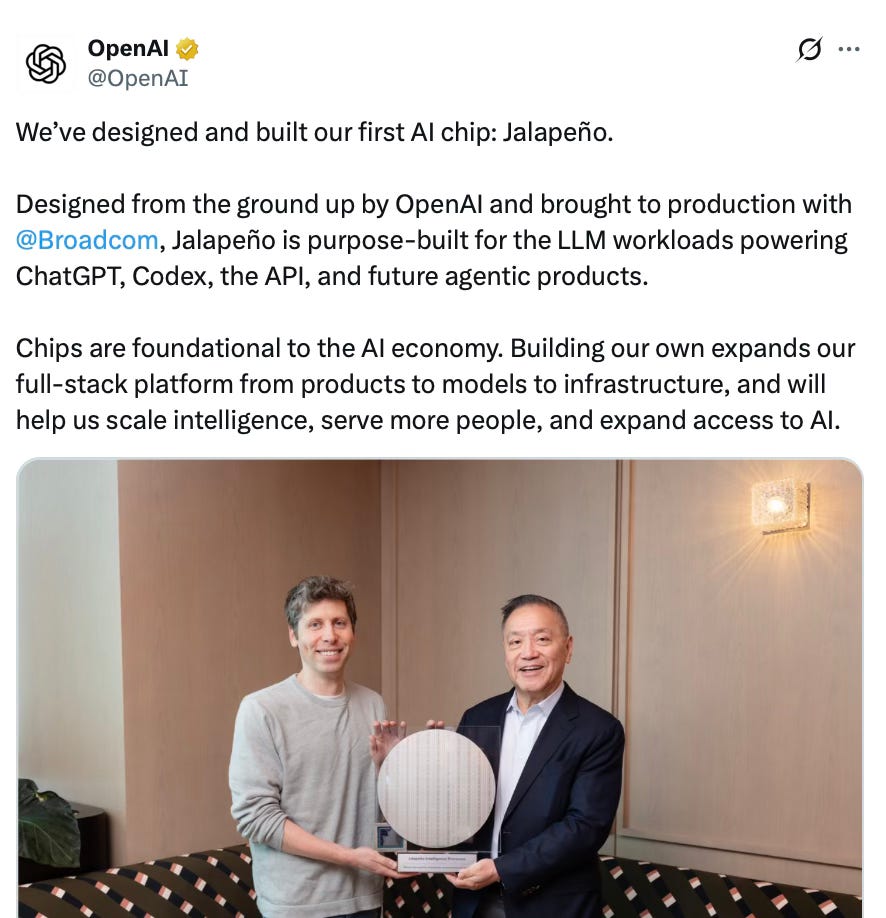
These join a list that was already long: OpenAI unveiled Jalapeño, its first custom inference chip built with Broadcom.
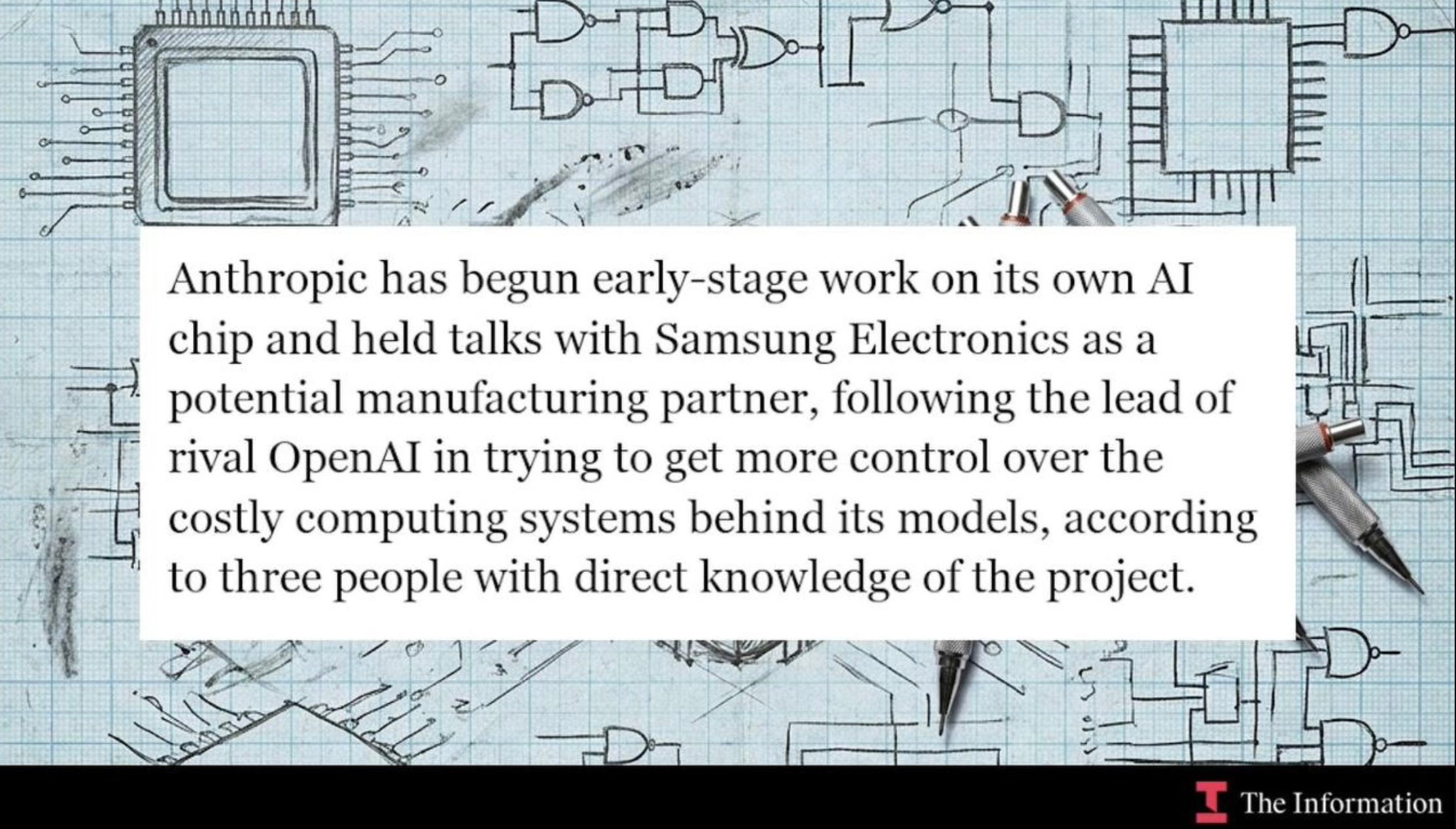
Anthropic is reportedly exploring one with Samsung.
Google has run TPUs for years; Amazon has Trainium. Every serious model builder is now paired with a chipmaker, designing silicon for itself.
Worth noticing is the thing that unites the new entrants: they are all inference chips, not training chips. Hold onto that. It’s the tell.
But also yesterday, Reuters reported that Beijing has been holding meetings with Alibaba, ByteDance, and Z.ai about restricting overseas access to China’s most advanced models — including, notably, open-weight ones. No decision, no timeline. But the direction is unmistakable, and it lands at the exact moment American enterprises have started to appreciate what open models offer.

The hinge
For the past year, the strategic value of Chinese open-weight models was partly that they were open. Released to the world at a fraction of US pricing, they did real damage to the pricing power of American labs and have captured significant market share as the frontier models changed pricing schemes and the invoices started reaching the CFO desks. It was less espionage than economic disruption, and structurally closer to dumping. Cheap, capable, and ownable weights were a weapon against the closed frontier and enterprises started seeking that.
Now the same government that benefits from that disruption is considering shutting the door (open weights included). Which means Beijing is weighing whether to sacrifice its most effective tool for damaging US labs in order to keep its best models at home.
That is not a contradiction. It is a choice between two things a state can want: to disrupt a rival, or to control an asset. This week suggests China is leaning toward control. And once you see that, the American export-control regime and this Chinese one stop looking like opposites. They look like the same instinct arriving from two directions — frontier AI reclassified from a traded good into a controlled strategic asset. The US got there first, with domestic firms largely controlling the most powerful chips (Nvidia) and frontier models (OpenAI, Anthropic, Google). But the Fable and Mythos suspension in June was the live demonstration that access can simply vanish. China is now getting there too.
So we have two facts. Firms are pulling silicon in-house. States are walling off their stacks. The question is whether these are two stories or one.
One coin
They are one coin, and the logic is simple enough to state once.
At sufficient scale, controlling a dependency beats renting a better version of it. When you are small, depending on someone else’s chip (or someone else’s country’s technology) is fine. The dependency is cheap and the counterparty has no reason to squeeze you.
But when you are large, every layer you don’t own becomes a lever someone else can pull. A supplier that can raise your prices, ration your supply, or cut you off entirely. Past a certain volume, owning a worse version of that layer is worth more than renting the best one, because the rented one comes with a hand on the valve.
That single principle explains all of it. What changes between the stories is only who is afraid of whom.
A firm fears its supplier, so it builds its own chip. That is OpenAI, Anthropic, DeepSeek, Zhipu.
A state fears another state, so it walls off its stack. That is US export controls and Beijing’s model restrictions.
An enterprise fears its vendor, so it wants models it can run and own (and perhaps even physically own on-prem), which is why open weights suddenly mattered, something Palantir’s Alex Karp has been selling in his rants this week. Enterprises need to control their data and alpha (the durable competitive advantage built through proprietary knowledge, data, relationships, workflows, and business models that competitors cannot easily copy).
In each instance, they are trying to remove any potential points of failure at three altitudes. Not three trends. One reorganization of the market around control as the unit of value, seen from three vantage points.
This is also why the chips are inference chips (for serving customers vs. for training new models). Training is where the capability race lives, and where the hardest constraints bite. The most advanced manufacturing still runs through a single Dutch supplier’s lithography tools that China cannot legally buy. Inference is where the recurring cost lives. Crucially, it can be built on mature manufacturing that everyone can access. The inference chip is the one piece of silicon a blacklisted Chinese lab can actually make. So it is simultaneously the margin play and the sovereignty play. DeepSeek and Zhipu building inference chips isn’t a China story. It the whole industry’s answer to the question which layer can we actually own.
A firm wants to integrate globally. A state wants to partition nationally. A buyer wants to deploy privately. Run the same de-risking logic from three seats and they crash into each other. The firm’s global stack meets the state’s border, the buyer’s demand for ownership meets the vendor’s model. That friction is what you’d expect if one force were operating on all three. It is the fingerprint of a single cause.
What it means
For three years the public scoreboard has been intelligence: benchmarks, model launches, who is ahead this month. That scoreboard is still running. But watch what the players are actually spending on, and it isn’t the next point of benchmark performance. It’s silicon they can own, stacks they can wall, and models they can keep home.
The counterintuitive part is that they’re doing both at once. They are still racing to build the smartest model while quietly betting that smartness won’t be what decides it. Every move this week is a wager that capability converges and control decides. If that’s right, the benchmark race we’re all watching is scoring a game that its own players have concluded is already almost over.
What began as a race to intelligence has become a race to moats — national and stack. The intelligence was never the prize. The position was.